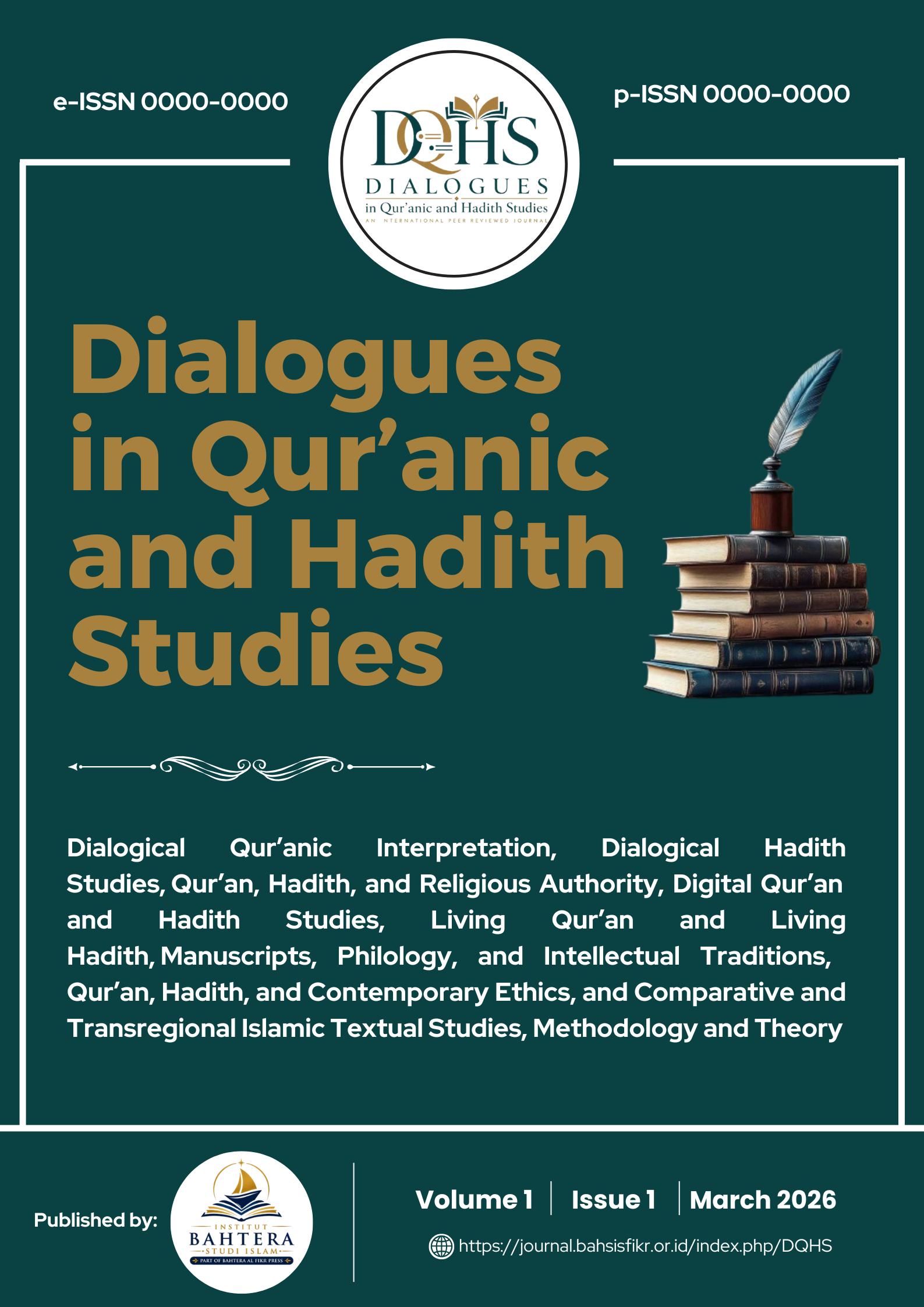
Competing Qur’anic Authorities in the Public Sphere: Textual Meaning, Social Contestation, and Interpretive Politics in Contemporary Indonesia
Keywords:
Qur’anic authority, public sphere, interpretive politics, digital Islam, Indonesian IslamAbstract
This article examines how Qur’anic authority is constructed, contested, and circulated in contemporary Indonesian public discourse. While Qur’anic interpretation has often been studied through exegetical content, theological method, or textual genealogy, less attention has been given to the mechanisms through which Qur’anic textual authority becomes public authority in legal, political, digital, and civic arenas. Focusing on Indonesia’s post-Reformasi public sphere, this study analyzes the contestation surrounding Q. al-Mā’idah 5:51, the translation of awliyā’, digital Islamic media, and state discourse on moderasi beragama. Methodologically, the article employs a qualitative textual and socio-discursive design, combining document analysis, critical discourse analysis, qualitative content analysis, and socio-hermeneutic interpretation. The primary corpus includes MUI’s institutional statement, the North Jakarta District Court decision, Qur’anic translation platforms, NU Online tafsir articles, Islami.co discourse, and Kementerian Agama policy documents. The findings show that Qur’anic authority in Indonesia is produced through four interrelated processes: institutional humidification, semantic contestation, digital fragmentation, and state-mediated civic reframing. MUI’s intervention converted scriptural interpretation into public legitimacy and legal relevance; competing translations of awliyā’ shaped different political and social meanings; digital platforms expanded and fragmented Qur’anic publics; and moderasi beragama reframed Qur’anic public ethics through civic norms. The article contributes to Qur’anic studies and Islamic hermeneutics by conceptualizing Qur’anic interpretation as a socio-discursive public practice in which sacred textual meaning becomes authoritative through institutions, translation, media, law, and state governance.
Keywords: Qur’anic authority; public sphere; interpretive politics; digital Islam; Indonesian Islam.
References
Afwadzi, B, U Sumbulah, N Ali, and S Z Qudsy. “Religious Moderation of Islamic University Students in Indonesia: Reception of Religious Texts.” HTS Teologiese Studies / Theological Studies 80, no. 1 (2024). https://doi.org/10.4102/hts.v80i1.9369.
Akmaliah, W. “The Demise of Moderate Islam: New Media, Contestation, and Reclaiming Religious Authorities.” Indonesian Journal of Islam and Muslim Societies 10, no. 1 (2020): 1–24. https://doi.org/10.18326/ijims.v10i1.1-24.
Alnizar, F. “The Language of Exclusion: Ideology and Power in the Fatwa of the Majelis Ulama Indonesia on Ahmadiyah.” Journal of Islamic Law 6, no. 1 (2025): 67–88. https://doi.org/10.24260/jil.v6i1.3338.
An, A N, A M Amir, M Z B Husain, F H Ismail, M S B Sahimi, F Fansuri, M Amri, F Arfan, and A Rhain. “Millennial Era Islamic Parenting Studies: A Bibliometric Analysis Utilizing the Scopus Database.” Multidisciplinary Reviews 8, no. 1 (2025). https://doi.org/10.31893/multirev.2025002.
Arifianto, Alexander R. “Rising Islamism and the Struggle for Islamic Authority in Post-Reformasi Indonesia.” TRaNS: Trans-Regional and National Studies of Southeast Asia 8, no. 1 (2020): 37–50. https://doi.org/10.1017/trn.2019.10.
Asad, Talal. The Idea of an Anthropology of Islam. Washington, DC: Center for Contemporary Arab Studies, Georgetown University, 1986.
Atallah, F A. “Digital Mediation and Fatwa Authority in Contemporary Islam: A Critical Islamic Legal and Media-Theoretical Framework.” Religions 17, no. 3 (2026). https://doi.org/10.3390/rel17030350.
Athoillah, M, A S Rahman, A S Firdaus, and M A Septiadi. “Policies And Practices Religious Moderation In Pesantren.” Jurnal Pendidikan Islam 10, no. 2 (2024): 387–96. https://doi.org/10.15575/jpi.v10i2.27543.
Bowen, Glenn A. “Document Analysis as a Qualitative Research Method.” Qualitative Research Journal 9, no. 2 (2009): 27–40.
Bunt, Gary R. Hashtag Islam: How Cyber-Islamic Environments Are Transforming Religious Authority. Chapel Hill: University of North Carolina Press, 2018.
Campbell, Heidi A. Digital Religion: Understanding Religious Practice in New Media Worlds. Routledge, 2013.
Center, Pew Research. “5 Facts about Muslims and Christians in Indonesia.” Pew Research Center, 2024. https://www.pewresearch.org/short-reads/2024/03/28/5-facts-about-muslims-and-christians-in-indonesia/.
Chaplin, C. “Religious Authority in the Urban Mosque: Islamic Activism and the Ethics of ‘Being Present’ in Eastern Indonesia.” American Ethnologist 52, no. 2 (2025): 159–70. https://doi.org/10.1111/amet.13388.
Çoruh, H. “Friendship between Muslims and the People of the Book in the Qur’an with Special Reference to Q 5.51.” Islam and Christian-Muslim Relations 23, no. 4 (2012): 505–13. https://doi.org/10.1080/09596410.2012.712436.
Creswell, John W, and Cheryl N Poth. Qualitative Inquiry and Research Design. Sage Publications, 2018.
Damayanti, R. “The Relevance of Fiqh Siyasah Dauliyah and Religion as Indonesian Soft Power in International Relations.” De Jure: Jurnal Hukum Dan Syar’iah 15, no. 2 (2023): 343–65. https://doi.org/10.18860/j-fsh.v15i2.23371.
DataReportal. “Digital 2025: Indonesia.” DataReportal - Global Digital Insights, 2025. https://datareportal.com/reports/digital-2025-indonesia.
Dharta, F Y, T Susanto, R Anggara, F Hariyanto, and H R P Sianturi. “MUI’s Fatwa on Interfaith Greetings and Religious Tolerance: Can Indonesia Find a Middle Ground?” Frontiers in Communication 10 (2025). https://doi.org/10.3389/fcomm.2025.1537568.
Dhuhri, S, S E Bhakti, N K Fauziyah, and R Wahyudi. “Dislocation Of Islamic Scientific Tradition Through Digital Public Sphere: Netnographic Analysis On The Discourse Of Ahl Al-Sunnah Wa Al-Jama’a Between Traditionalist And Modernist Muslims.” Jurnal Ilmiah Islam Futura 25, no. 1 (2025): 204–38. https://doi.org/10.22373/jiif.v25i1.25776.
Fairclough, Norman. Critical Discourse Analysis: The Critical Study of Language. Longman, 1995.
———. Discourse and Social Change. Cambridge: Polity Press, 1992.
Fealy, G. “The Political Contingency of Reformmindedness in Indonesia’s Nahdlatul Ulama: Interest Politics and the Khittah.” In Islamic Legitimacy in a Plural Asia, 154–66, 2008. https://doi.org/10.4324/9780203933404-16.
Fealy, Greg, and Sally White. Expressing Islam: Religious Life and Politics in Indonesia. Singapore: Institute of Southeast Asian Studies, 2008.
Fenwick, S. “Eat, Pray, Regulate: The Indonesian Ulama Council And The Management Of Islamic Affairs.” In Journal of Law and Religion, 33:271–90, 2018. https://doi.org/10.1017/jlr.2018.23.
Fraser, Nancy. “Rethinking the Public Sphere: A Contribution to the Critique of Actually Existing Democracy.” Social Text, no. 25/26 (1990): 56–80. https://doi.org/10.2307/466240.
Gusmian, Islah. Khazanah Tafsir Indonesia: Dari Hermeneutika Hingga Ideologi. Jakarta: Teraju, 2013.
Habermas, Jürgen. The Structural Transformation of the Public Sphere. MIT Press, 1989.
Hamim, K, L S Bin Mujib, and A Muhasim. “Religious Fatwā and Human Security: Managing Public Health through the Lens of Islamic Jurisprudence in Indonesia and Saudi Arabia.” Khazanah Hukum 6, no. 3 (2024): 234–50. https://doi.org/10.15575/KH.V6I3.40478.
Hefner, Robert W. Civil Islam: Muslims and Democratization in Indonesia. Princeton University Press, 2000.
Herlina, S, and E Istikomah. “Implementation Digital Literacy of Textbook of Statistics 1 for Islamic Religious Education Students.” In AIP Conference Proceedings, Vol. 2734, 2023. https://doi.org/10.1063/5.0155539.
Ilahi, M R, M N Irfan, K Kamarusdiana, H Hidayatulloh, and E A Zulfa. “Fatwa Institutions in Handling Religious Blasphemy Crimes in Indonesia and Malaysia.” Al-Ahkam 34, no. 1 (2024): 33–62. https://doi.org/10.21580/ahkam.2024.34.1.18624.
Indonesia, Asosiasi Penyelenggara Jasa Internet. “APJII Jumlah Pengguna Internet Indonesia Tembus 221 Juta Orang.” APJII, 2024. https://apjii.or.id/berita/d/apjii-jumlah-pengguna-internet-indonesia-tembus-221-juta-orang.
Indonesia, Kementerian Agama Republik. “Qur’an Kemenag.” Lajnah Pentashihan Mushaf Al-Qur’an, Kementerian Agama Republik Indonesia, 2022. https://quran.kemenag.go.id/.
Indonesia, Majelis Ulama. “Pendapat Dan Sikap Keagamaan Majelis Ulama Indonesia Terkait Pernyataan Basuki Tjahaja Purnama.” Majelis Ulama Indonesia, 2016. https://mirror.mui.or.id/berita/10590/pendapat-dan-sikap-keagamaan-mui-terkait-pernyataan-basuki-tjahaja-purnama/.
Jafar, N, M Lampe, M J Muhammad, D Muhamad, A I Guntur, and A Hasyim. “Gender And Religiosity In Indonesian Popular Media: An Anthropological Reading Of Cultural Representations.” Jurnal Lektur Keagamaan 23, no. 2 (2025): 667–95. https://doi.org/10.31291/jlka.v23i2.1489.
Kharrazi, M, I Fautanu, and A Suganda. “Legal Analysis Of Mui’s Authority In Providing Halal Label Guarantees After The Issuance Of Law Number 33 Of 2014 Concerning Guarantees For Halal Products.” Revista de Gestao Social e Ambiental 18, no. 9 (2024). https://doi.org/10.24857/rgsa.v18n9-057.
Kholid, A, A Bakar, and M Zamzami. “Rereading the Indonesian Interpretation of the Qur’an on Awliya’: The Cases of Hamka and m. Quraish Shihab.” Qudus International Journal of Islamic Studies 9, no. 1 (2021): 37–72. https://doi.org/10.21043/QIJIS.V9I1.7567.
Krippendorff, Klaus. Content Analysis: An Introduction to Its Methodology. 4th ed. Thousand Oaks, CA: SAGE Publications, 2019.
Long, N J. “On the Islamic Authority of the Indonesian State: Responsibility, Suspicion, and Acts of Compliance.” Journal of the Royal Anthropological Institute 23, no. 4 (2017): 709–26. https://doi.org/10.1111/1467-9655.12698.
Mahzumi, F, A Aminuddin, H Mahfudh, and M M Sm. “Cyber-Islamic Moderation In Indonesia: Digital Activism of Islami.Co and IBTimes.Id and Its Implications for Young Muslims.” Miqot: Jurnal Ilmu-Ilmu Keislaman 49, no. 1 (2025): 22–49. https://doi.org/10.30821/miqot.v49i1.1290.
Menchik, Jeremy. Islam and Democracy in Indonesia: Tolerance without Liberalism. Cambridge: Cambridge University Press, 2016. https://doi.org/10.1017/CBO9781316344446.
Millie, J. “An Anthropological Approach to the Islamic Turn in Indonesia’s Regional Politics.” TRaNS: Trans-Regional and -National Studies of Southeast Asia 6, no. 2 (2018): 207–26. https://doi.org/10.1017/trn.2018.6.
Muhammadiyah. “Al-Ma’idah: 51.” QuranMu: Al-Qur’an Digital Muhammadiyah, 2026. https://quran.muhammadiyah.or.id/al-maidah/51.
Muji Buddin SM, M, D Sulistio, M I Achfandhy, M A Sidik, and M N Mubin. “Islamic Law, The Constitution, And Digital Media: A Study of Islamic Discourse Construction in Contemporary Indonesia.” Al-Risalah: Forum Kajian Hukum Dan Sosial Kemasyarakatan 25, no. 2 (2025): 20–36. https://doi.org/10.30631/alrisalah.v25i2.1951.
Mursyid, A Y, and A Nahdiyati. “State-Sponsored Quranic Exegesis: A Comparative Analysis of Turkiye’s and Indonesia’s Official Tafsir.” AlBayan 22, no. 3 (2024): 439–68. https://doi.org/10.1163/22321969-20240159.
Musafa’ah, S, M N Hadi, M A Al Maliki, and M Ghufron. “Reframing Islamic Family Law Through Web-Based Tafsir: The Case of Nushuz in the Indonesian Tafsir Online.” Ulumuna 29, no. 2 (2025): 666–700. https://doi.org/10.20414/ujis.v29i2.1756.
Musaffa, M U A. “Language Politics and Fiqh’s Authority on Qur’anic Reinterpretation in Indonesian Translation Practices.” Al-Mazaahib 13, no. 1 (2025): 114–21. https://doi.org/10.14421/al-mazaahib.v13i1.4357.
Mustafid, F, K Nasution, and A Sodiqin. “Positivization of the Council of Indonesian Ulema’s Halal Fatwa: Policy and Position in Indonesian Legislation.” Juris: Jurnal Ilmiah Syariah 23, no. 1 (2024): 155–66. https://doi.org/10.31958/juris.v23i1.10859.
Nasution, A A, S A Kesuma, J Agustrisna, M H B Rangkuti, and N M A Aziz. “The Implementation of the Islamic Accounting Standard for Zakah, Infaq, and Shadaqah (ZIS) in Indonesia.” In Lecture Notes in Networks and Systems, 1083 LNNS:444–56, 2024. https://doi.org/10.1007/978-3-031-67431-0_43.
Nisa, Eva F. “Social Media and the Birth of an Islamic Social Movement: ODOJ (One Day One Juz) in Contemporary Indonesia.” Indonesia and the Malay World 46, no. 134 (2018): 24–43. https://doi.org/10.1080/13639811.2017.1416758.
Online, N U. “Surat Al-Ma’idah Ayat 51: Arab, Latin, Terjemah Dan Tafsir Lengkap.” NU Online, n.d. https://quran.nu.or.id/al-maidah/51.
———. “Surat Al-Ma’idah Ayat 51 Menurut Tafsir Jamal.” NU Online, 2016. https://islam.nu.or.id/tafsir/surat-al-maidah-ayat-51-menurut-tafsir-jamal-j4Ucy.
———. “Tafsir Al-Ma’idah 51 Menurut Ibn ’Abbas.” NU Online, 2016. https://islam.nu.or.id/tafsir/tafsir-al-maidah-51-menurut-ibnu-abbas-5fvM1.
Pelu, I.E.A.S., and J Tarantang. “Fatwa Majelis Ulama Indonesia Sebagai Solusi Permasalahan Umat Islam Di Indonesia.” Al-Manahij: Jurnal Kajian Hukum Islam 14, no. 2 (2020): 307–16. https://doi.org/10.24090/mnh.v14i2.3927.
Pink, J. “Tradition and Ideology in Contemporary Sunnite Qur’ānic Exegesis: Qur’ānic Commentaries from the Arab World, Turkey and Indonesia and Their Interpretation of Q 5:51.” Welt Des Islams 50, no. 1 (2010): 3–59. https://doi.org/10.1163/157006010X489801.
Rahman, Yusuf, and Ervan Nurtawab. “Western Qur ’ Anic Studies In Indonesian Islamic Universities” 62, no. 2 (2024): 337–61. https://doi.org/10.14421/ajis.2024.622.337-361.
RI, Badan Litbang dan Diklat Kementerian Agama. Moderasi Beragama. Jakarta: Kementerian Agama RI, 2019.
Rismawati, S D, S Qomariyah, H S Devy, N Maisyal, and Q A’yun. “The Legal Politics of Religious Moderation in Indonesia: Responsive or Repressive?” Journal of Legal, Ethical and Regulatory Issues 24, no. 4 (2021): 1–8. https://www.scopus.com/inward/record.uri?eid=2-s2.0-85108870899&partnerID=40&md5=0aab875b7559286a1c691d965d148687.
Rohid, N. “Islamic Discourse and Political Mobilization on Indonesian Social Media.” Journal of Digital Islam 10, no. 2 (2025): 140–59.
Rohmana, Jajang A. Sejarah Tafsir Al-Qur’an Di Tatar Sunda. Bandung: Mujahid Press, 2017.
Sahimi, M S B, M H A Rahim, A A B Rushihi, A Kirin, and N Zakaria. “Preserving the Authenticity of Quranic Exegesis Through Artificial Intelligence: A Proposed Framework for Digital Verification.” Quranica 17, no. 2 (2025): 325–44. https://www.scopus.com/inward/record.uri?eid=2-s2.0-105018592981&partnerID=40&md5=0f97d0de1636bddbe68eca85e15581b6.
Saleh, S G, M A S Khasawneh, E.A.A.E. Hassan, and S M Ismail. “A Critical Review of Hermeneutic Approaches to Language and Translation: Theoretical Foundations, Interpretative Challenges, and Implications for Cross-Cultural Communication.” Forum for Linguistic Studies 7, no. 4 (2025): 511–26. https://doi.org/10.30564/fls.v7i4.8802.
Saleh, W A. “Contemporary Tafsīr: The Rise of Scriptural Theology.” In The Oxford Handbook of Qur’anic Studies, 693–703, 2020. https://doi.org/10.1093/oxfordhb/9780199698646.013.56.
Sevinç, B. “Activist Muslim Students’ Perspectives on Digital Public Sphere and the Power of Activism in the USA.” Sociology Lens 38, no. 4 (2025): 314–23. https://doi.org/10.1111/johs.70012.
Sianturi, P R, J N Pardede, and S D Riadi. “Rebalancing Religious Policy and the Concept of Public Sphere: Indonesia Cases.” Udayana Journal of Law and Culture 5, no. 2 (2021): 119–37. https://doi.org/10.24843/UJLC.2021.v05.i02.p02.
Slama, Martin. “Practising Islam through Social Media in Indonesia.” Indonesia and the Malay World 46, no. 134 (2018): 1–4. https://doi.org/10.1080/13639811.2018.1416798.
Supriyanto, Supriyanto, and Akhmad R B Zaman. “Living Quran in the Context of Rural Communities: A Study on the Miracle of the Quran in Gentasari, Kroya, Cilacap.” Al-Bayān – Journal of Qurʾān and Ḥadīth Studies 21, no. 2 (2023): 199–216. https://doi.org/10.1163/22321969-20230132.
Tahir, M, T Bashir, M Mubeen, A B U Farooq, S Mehmood, M Saleem, U Khan, et al. “Water Shortage and Role of Biotechnology.” In Innovations in Agricultural Water Management: Risks and Solutions, 345–68, 2025. https://doi.org/10.1007/978-3-031-91883-4_17.
Taufiq, M, and M Said. “Qur’anic Interpretation among Sasak Muslims across Communities, Theologies, and Ideological Conflicts.” Jurnal Studi Ilmu-Ilmu Al-Qur’an Dan Hadis 26, no. 2 (2025): 383–412. https://doi.org/10.14421/qh.v26i2.6287.
Thresher, K. “The Role of Majelis Ulama Indonesia in Blasphemy Trials in East Java.” Australian Journal of Asian Law 25, no. 2 (2025): 103–20. https://www.scopus.com/inward/record.uri?eid=2-s2.0-105000050618&partnerID=40&md5=2c82bfac08ce7a8d322b15bbf3dbaa10.
Tinambunan, E R L, I K Gegel, P B Sarbini, and G Z Baik. “Implication Abu Dhabi Document: To Build Religious Moderation with Brotherhood-Sisterhood and Friendship in Indonesia.” Cogent Arts and Humanities 12, no. 1 (2025). https://doi.org/10.1080/23311983.2025.2451514.
Tsaqofi, Wildan Ahmad, Asep Saehudin, and Siti Hajar Mahmudah. “Power of Translation of QS. Al-Ma’idah 51 on the Conservative Islamic Website in Indonesia.” Lingua Didaktika: Jurnal Bahasa Dan Pembelajaran Bahasa 17, no. 1 (2023): 57–70. https://doi.org/10.24036/ld.v17i1.121305.
Tsaqofi, Wildan Ahmad, Akhmad Satori, Siti Hajar Mahmudah, Asep Saehudin, Ulil Abshar, and Li Wenhua. “Digital Religious Discourse: Constructing Legitimacy and Counter-Narratives in Islami.Co.” Mimbar Agama Budaya 42, no. 1 (2025): 225–38. https://doi.org/10.15408/mimbar.v42i1.48924.
Wahid, S H, and S Abdulloh. “Digital Islamic Authority: A Revolutionary Shift or Mere Hype? A Systematic Review.” SN Social Sciences 6, no. 2 (2026). https://doi.org/10.1007/s43545-026-01328-5.
Yahya, I, and S Susilo. “Conservative Muslims in Indonesia’s Religious and Political Landscapes: Ahok’s Blasphemy Case as a Political Leverage.” Cogent Social Sciences 10, no. 1 (2024). https://doi.org/10.1080/23311886.2024.2392293.
Zaid, B, M Ibahrine, and M Ben Moussa. “Networked Islam and Liquid Authority: Everyday Influencers and Young Muslim Practice.” New Media and Society, 2026. https://doi.org/10.1177/14614448261436035.
Zuhri, S. “Regimented Islamophobia: Islam, State, And Governmentality In Indonesia.” Qudus International Journal of Islamic Studies 9, no. 2 (2021): 387–422. https://doi.org/10.21043/qijis.v9i2.8249.
Downloads
Published
How to Cite
Issue
Section
License
Copyright (c) 2026 Dialogues in Qur’anic and Hadith Studies

This work is licensed under a Creative Commons Attribution 4.0 International License.